
Perhaps the most lively element of campus life is the sheer random chance at play while walking around. As much as one might try to find and enjoy every student-led event in a given day, the only real way to find some events happening on campus is word-of-mouth or pure dumb luck. I can personally attest to walking around on campus and finding a student band playing in front of the UNC, free ice cream served by the Ice Cream Club, and a community market in the EME which I would never have heard about except by accident.
On a campus this big, though still small enough for certain events to be semi-private, you can find almost anything. Nevertheless, there are also things that are as reliable as the sun rising in the morning and setting at night.
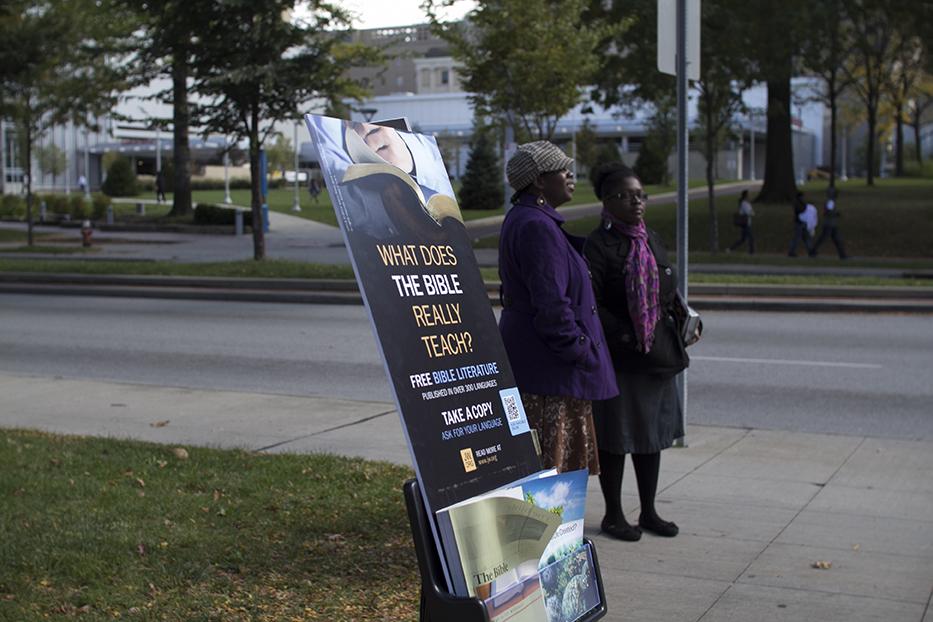
Most days at the bus shelter, or in front of the Arts building, or in front of the Science building, there are a pair of smartly-dressed people, hands in pockets, chatting with one another in front of a book stand, filled with pamphlets. At the top, there are various philosophical inquiries, though only one at a time: "How do we end war?" or something like it was the one title I remember best.
My gut instinct was that they were a Christian group of some kind, evangelizing — and to put all the cards on the table, I would know, since I have spent more than my fair share of afternoons handing out free hot chocolate while tabling. I contemplated these people as I went home for the reading break, then left for Victoria and Nanaimo. Walking to my favourite Vietnamese restaurant, I glanced across the street, and saw another pair of well-dressed people with the exact same stand of pamphlets. Then, in Victoria, I saw the exact same thing. I had never realized how prominent these people were until that precise moment.
The thick and tangled history of the nigh-unlimited number of Christian denominations is neither the point of this article nor an altogether compelling topic, but it is necessary to understand exactly what a Jehovah's Witness actually is — though I would suggest you speak with those on campus if you have an interest in just that. While I could go through the weeds on precisely what that means, it would be quicker to simply describe the most interesting positions, though please note that especially here, no list is comprehensive.
To be brief, they uniformly do not believe in the following: serving in the armed forces, the notion that God exists in three distinct persons (that is, Father, Son, and Holy Spirit, as most Christians do), and celebrating most holidays like Christmas, Easter, or birthdays.
Obviously there is more to the group than what they are against — the Jehovah's Witnesses use their own translation of the Bible, that being The New World Translation of the Holy Scriptures, for instance, and that fact paired with those last two points about the Holy Trinity and holidays have generated an awful lot of discussion about whether or not the group qualifies as being Christian at all (a debate to which there remains very little consensus). Regardless, what most everyone best knows the Jehovah's Witnesses for are their constant, unrelenting evangelizing.
I would recommend you read up on the topic more in your own time, as I am not a member of that church and thus cannot accurately represent it here, though what I can do is explain what they are and speak to the presence of similar groups on campus — though again, you should speak with them directly if you want to know more.
The Jehovah's Witnesses are by no means a small church, though their influence has always been outsized thanks to their focus on evangelizing as much as possible. That used to look like going door knocking, house to house, though evidently the most time-efficient way to search for would-be converts is now seen as canvassing with pamphlet stands, as we see on our campus today.
I spent some time speaking with some of the people pamphleteering, and they seemed generally good-natured.Of the three pairs of Witnesses I spoke with, there was always one person who did most of the talking, though the conversations were interesting enough nonetheless. I spoke with one particular member, someone who I will call "Michael" for the sake of anonymity, and we had an interesting conversation in front of the pamphlet stand offering solutions to the answers of rising inflation. It was also a conversation I did not record out of respect, so I can convey only the general facts, as follows:
The purpose of the pamphleteers is more or less to get people to read the pamphlets, so much as to direct them to an online course reached via QR code. "Enjoy Life Forever! Introductory Bible Lessons" is the name of the course reached from the code. Reading through the complimentary chapters available online ("complimentary," at least, in the sense that I did not need to sign up for the equally free larger program), the sections give plenty of broad topic discussions: "How did life begin?” “Why are we here?” “Why do innocent people suffer?” “What happens when a person dies?” “If everyone wants peace, why is there so much war?” “What will happen to the Earth in the future?", and so on.
Those questions are fairly typical for most generic Christian Bible study courses, however. While the rest of the course is locked behind a sign-up sheet, what I can tell you is that the other programs offered on the JW.org site are predominantly standard fare for what one might expect from a religious website — take that exactly as you will. It includes generic calls to faith, a broad description of Christianity, going over the rough outlines of “have faith and ye will be rewarded, etc.” While most Christian websites tend to go more in-depth into their own specific denomination’s views, the more evangelical nature of the Jehovah’s Witnesses outreach treats the reader as though they know very little about the Christian faith.
However, it is worth noting that the Jehovah's Witnesses are not the only religious group on campus.
Once in a while you will see some students walking around campus carrying a walking stick with beads on the handle — the odds are very high that those students would have gotten that walking stick from another religious group on campus, this one more mainstream in its Christian denomination. Some months ago, the SUO hosted an event for the various religious clubs on campus, and I recall walking over to speak with them out of curiosity; they seemed kind, predominantly older, though (unsurprisingly) excited to talk about religion — they gave me a free Bible, which I still do not know what to do with, so it occupies a slot in the "religious" part of my apartment's bookshelf.
Of the outside organizations represented on campus, the Jehovah's Witnesses and “The Walking Stick People” (not an official name, mind you) are the only groups which do outreach on campus from the outside — with the mainstream Christians typically at the courtyard or at the intersection between the Commons, UNC, and Fipke.
Of course, those are not the only religious groups on campus. I would be remiss not to mention the Muslim Students Association, the Sikh Students Association, or any other of the various religious clubs on campus, which I would encourage you to take the time to look into as well — you can learn more about them at UBCO's Spiritual and Multifaith Center. The point is, our campus is filled with various organizations, clubs, and events like these, from perennial potlucks to weekly meetings scattered throughout the buildings past dark.
There is an automatic hesitancy that many people are reasonably going to have on the topic of religion, and that is something I have encountered again and again, in myself as in others. Yet, I also know that there exists the capacity for people to better care for one another once they know each other better, no matter how wide the differences between those people might be.I can earnestly say that the friends I get along best with are also the ones I can candidly disagree with over sensitive topics precisely like that.
It is contrived and stereotypical, certainly, but I also know that people always better love and care for each other when they know more about the other person. Perhaps it has an overly idealistic notion, but it is also one that I have followed that has brought me closer together with other people, sometimes specifically because we disagree. Ultimately, though, that kind of call is not mine to make, but yours.



.png)

