
The word “solidarity” looks good on posters, Instagram stories, and in land acknowledgments. It sounds like progress, but solidarity has a way of getting stuck at the level of language. It is an easy way to show how strongly we feel, through rants and rage, but then what? What does solidarity require when the conversation asks you to confront your own community, not just point at someone else’s?
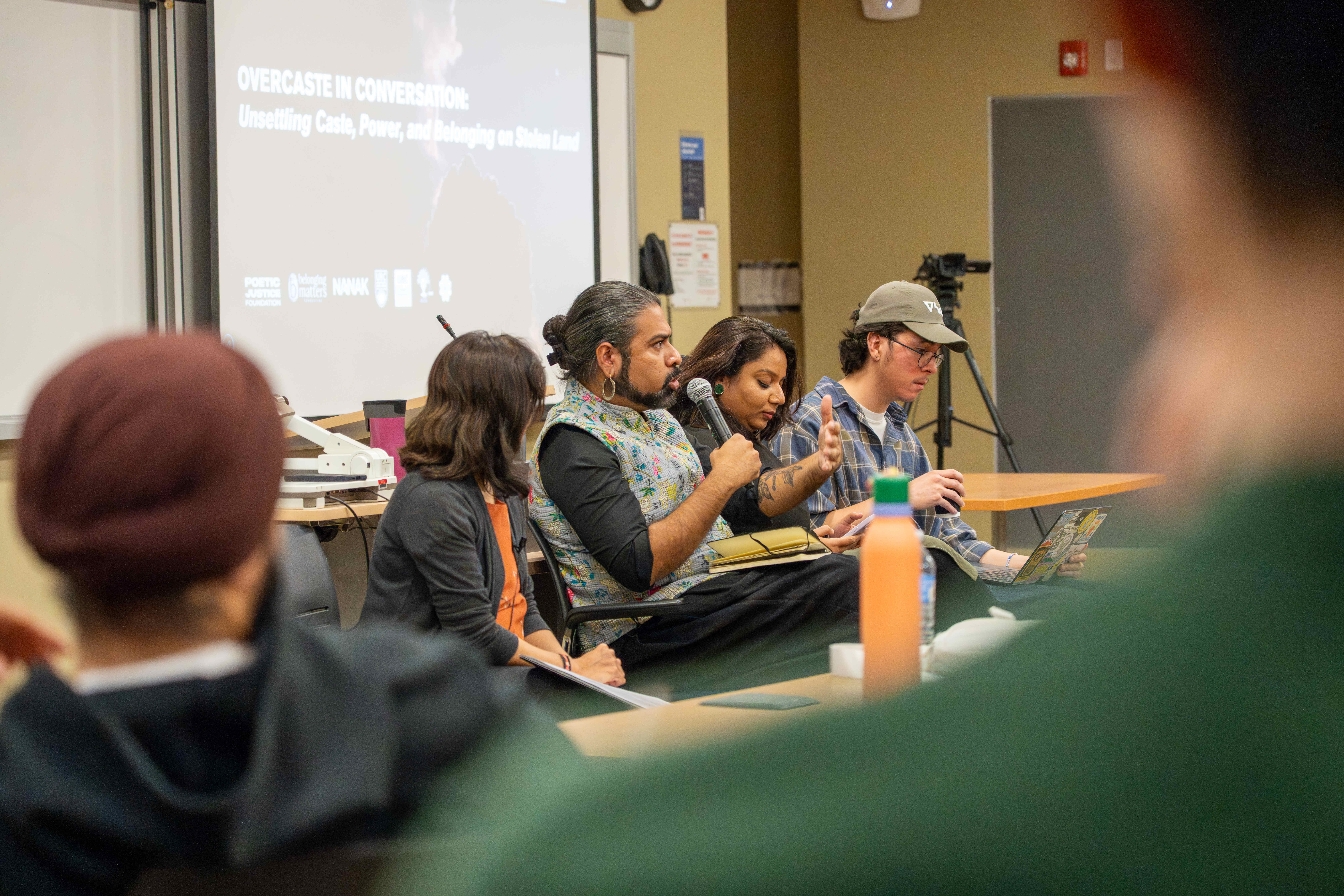
These questions, and the tension that follows, ran through Overcaste in Conversation: Unsettling Caste, Power, and Belonging on Stolen Land, a panel organized in collaboration with the Poetic Justice Foundation, the Indian Student Association, and UBC Community Engagement. Moderated by Dr. Neha Gupta, the event brought together Dr. Shikha Diwakar, Dr. Nishant Upadhyay, and Ty Bryant to discuss caste, settlerhood in diaspora, and what solidarity demands.
Some students drifted in for the free food and drifted out just quickly, treating the event like a quick pit stop between classes. But inside the room, a much heavier conversation was unfolding, one that had nothing to do with snacks.
The first question that anchored the panel sounded deceptively simple: What does the word “settler” mean to you?
Diwakar described encountering the term through land acknowledgements after moving from India to Canada. She emphasized the need to educate herself without flattening everyone into one category. Yes, she said, she is a settler, but not a “homogenous” one. Not everyone arrives in Canada with the same history or power. Her relationship with settlerhood circles back to accountability and the idea that solidarity is a practice.
Bryant agreed and pointed out how conversations about settlerhood can “run their course the way land acknowledgments do” when they stop at discourse. He wants to see action and execution, not just the right language.
Upadhyay argued that it matters less who gets labelled a settler and more what people are actually doing to decolonize structures and understand how they are complicit in them. “Settler can be a very dubious term,” he warned. “It can turn into a fight over who qualifies instead of what changes. That is not the purpose.”
The second question moved from labels to structure. What are the transnational links between brahmanic supremacy and white supremacy? How do we recognize these structures and call them out?
Brahmanism is an early form of the Hindu religious tradition that is based on the authority of the Brahmin priestly class and its rituals, seen as a precursor to later Hinduism (the world’s third largest religion). This system accentuated the caste system, where Brahmins are placed at the top.
Upadhyay described Brahmanism as central to caste violence and a “useful framework” for understanding white supremacy, because both systems keep old hierarchies alive through inherited status and normalized exploitation. He also pointed to a pattern shared across contexts of dominant groups often claiming victimhood when their power is questioned.
Diwakar grounded the pattern in everyday life. Arriving in Canada, “new to racism” but already familiar with casteism, she recognized how quickly the structures rhyme. As someone belonging to the Dalit community, she highlighted her experience when meeting new people — the casual questions that sound like curiosity but act like a sorting process. People’s obsession with names, surnames, and “where are your parents from?” serves to place you socially before conversation even begins.
Bryant added a political angle, describing these systems as formations that want to “actualize the certainty of a future.” He argued that colonial projects often behave like anxious machines or failed projects: they demand certainty, and so you get surveillance and control. If a system is truly stable, it does not need constant domination to prove itself, does it?
The third question asked what stops racialized communities from being in solidarity with Indigenous communities?
Bryant called the relationship complex, especially when people lump anti-racism and multiculturalism together. Indigenous communities are not another “minority group” within Canada’s multicultural story. They are nations living under an ongoing settler-colonial structure, and that changes what real solidarity looks like.
Diwakar added a newcomer’s perspective. When she first arrived, she was told to learn about Indigenous communities by visiting museums. It left her with a lingering question: if this land belongs to Indigenous communities, why is she learning about it through a museum? She also pointed out how, in terms of education, Indigenous knowledge can feel siloed into one course, instead of being treated as foundational.
The panel finally asked where does hope lie? None of the panelists offered a neat ending. Diwakar said that hope is not a mood; it is intention and relationality — how you treat people, build relationships, and what steps you take when there is no applause for it. Upadhyay admitted that academia trains people to be pessimistic, but said he has been trying to unlearn that, because hopelessness becomes an excuse to do nothing.
It is everyone’s responsibility, especially those belonging to a privileged background, to become educated, understand the history of the land they live on, and reflect on their power and place. Solidarity means confronting harm in your own community, not only the harm that is easy to criticize from a distance.


.png)

