
Following the recent release of Guillermo Del Toro’s Frankenstein, debates flared up online regarding the quality of the representation of women in the film. Specifically, the interest was whether or not Frankenstein was a sexist film. Naturally, this brought up the long discussed, and almost overused, ‘Bechdel test’.
The Bechdel test’s premise is pretty simple: a film will pass if it has at least two fully fleshed out female characters having a conversation with each other about something other than a man. Today, the Bechdel test is almost the knee-jerk reaction for movie reviewers seeking feminist films or films with good female representations in general, but should it really be?
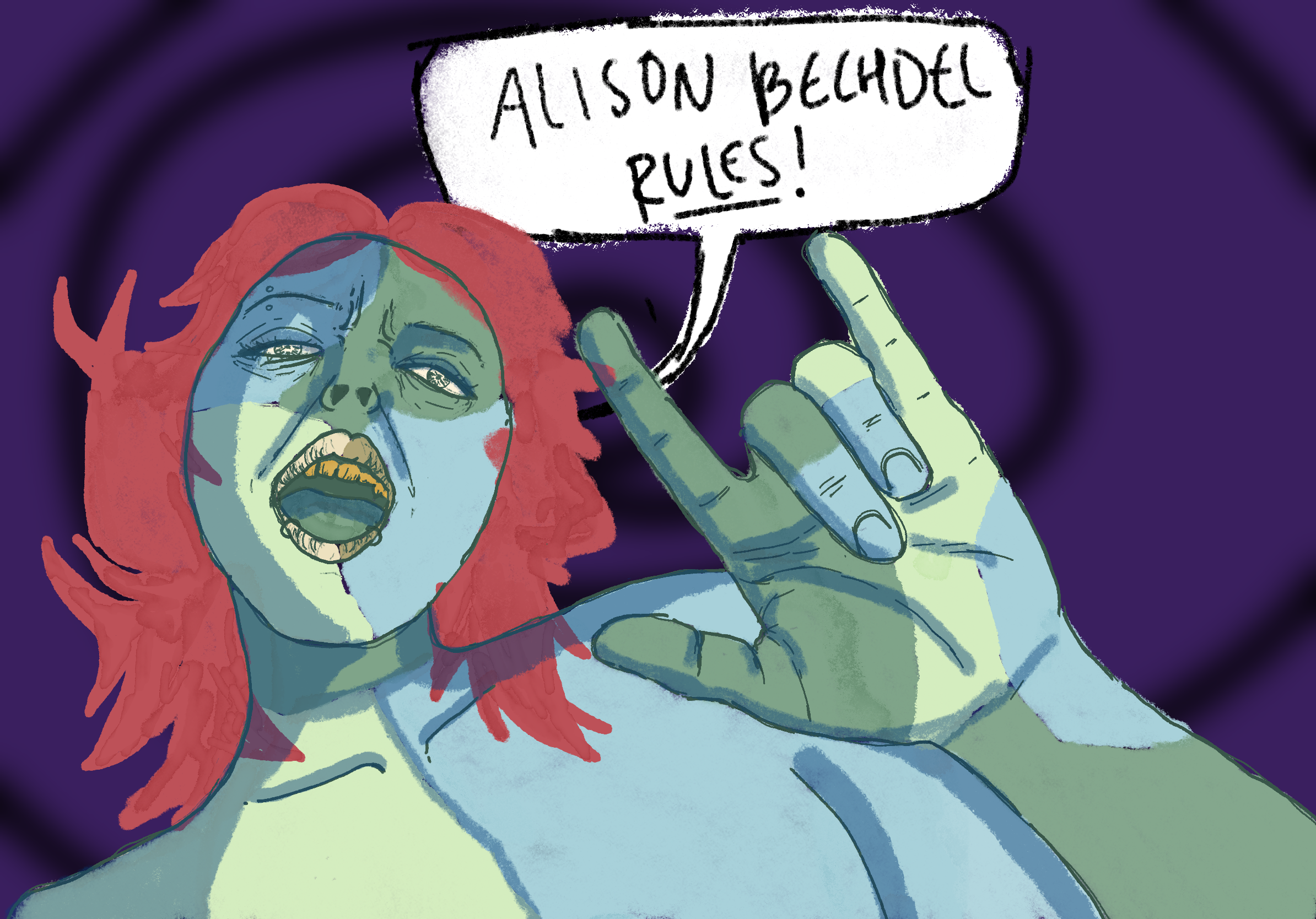
Alison Bechdel is an American cartoonist who has published many autobiographical graphic novels, including Fun Home, Are you my Mother?, and her most popular, Dykes to Watch Out For. The latter was a strip based comic depicting Bechdel and her friends’ lives as lesbians in an ever-changing world. One of these strips described a character only seeing movies that met the criteria laid out previously. Contrary to the belief of some that the Bechdel test is an immoveable theory about media, the strip simply uses this test to comment on the lack of female representation in film.
The test exploded in popularity, in part for its simplicity and in part for its shocking outcome: that not many movies pass such a low bar. Despite that, I believe it is incorrect to attempt to apply it to films as a ‘gotcha’ to definitively prove if a piece of media is or is not feminist.
Returning to Frankenstein, many have brought criticisms to the character of Emily, who has little agency with her decisions throughout the story. The film does not pass the Bechdel test by any of its stipulations, and Emily’s life is mostly used as a plot device to further the stories of the rest of the entirely male cast. This has reasonably led to others criticizing the film as sexist.
The representation in the film is poor, but is it truly sexist? The original novel was written by Mary Shelley, a female author who published Frankenstein in 1818. Many of her peers and inspirations during her life in colonial and male-dominated London were men. Mary Shelley is seen as a feminist figure in history because despite the social stigma assigned to female writers, Frankenstein was an immediate success and left a long-lasting impact on society as a whole.
All of this understood, we must ask ourselves if good representation of women in media inherently makes something feminist. Does a film with characters who accurately represent a very diverse group automatically promote feminist ideals? What even are those ideals truly?
Frankenstein is a distinctly feminist tale for its historical context and the discussion of ideas of othering and monstrosity which come from Mary Shelley’s experiences as a woman, which she outlines in the novel despite its male-centred cast. However, this does not negate that the representation within the novel and film are often lacking. The lack of distinction between good representation of women and feminism is part of what has led to the misinterpretation of Bechdel’s comic, as well the misinterpretation of many modern films and their female characters.
The original Bechdel comic aims to point out a worrying trend in mainstream film about how women are depicted and what that says about both the people who make films and our society at large. It is not a guide on how to represent women in film. Having a female character talk to another female character does not mean your film has good representation, and having good representation does not mean your film is feminist. These components are heavily linked but separate and they are far more complex than a pass/fail test.
Film and popular media does significantly sway the opinions of the public, especially in a Western context. That said, if the peak of your feminist understanding and petitioning comes in the form of white-knighting in Letterboxd reviews, you have a very long way to go.
What is far more important in any venture of representation is the desire to make truly well thought out and accurate decisions in the film using research and experience. No test can really sum up what is innately understood by other women to be a good and accurate representation. Including more female voices and influences within popular media will ultimately shift the principals of others and lead to far greater diversity in the voices and opinions told in film.



.png)

