
One Friday in December, 2025, my friend, Vivian, and I bussed downtown to Ellis St. Market for groceries. We were excited to scour the fridges for enoki mushrooms, whole sticks of lemongrass, and a sweet treat from the Japanese bakery which was humbly tucked in a corner of the market. Just two weeks prior, Vivian had gotten a red bean mochi from that bakery.
That Friday at 1 p.m., we entered to see half of the shelves empty, the fluorescent lights above barely lit. We asked the cashier if they were still open and he nodded. “Why are the shelves empty,” we followed up, “and what happened to the Japanese bakery?” The cashier said he did not know.
A mysterious wipe-out had occurred at Ellis St. Market, which used to house a galore of Asian food products. Around the same time, complaints surfaced on Reddit and Facebook regarding the same phenomena at other Asian grocery stores in Kelowna., On March 17, 2026, I visited Oriental Supermarket and the scene looked eerily similar to what Vivian and I had seen at Ellis St. Market.
In 2025, Kelowna saw a decline in population growth which has continued into the new year. UBC Okanagan currently hosts fewer international students compared to the 2021/22 school year. In 2025/26, the number of domestic students at UBCO went up by 3.8% compared to five years prior. Conversely, the international student population saw a 21% decline in the same time frame, according to Castanet Kelowna News writer, Colin Dacre.
The decrease in the international student population may have negatively impacted Asian grocery businesses. However, there remains a large number of Asian students and immigrants in Kelowna, and access to meals and ingredients from home is invaluable to their livelihoods.
In most Asian cultures, food plays a significant role in forming familial ties and expressing love. Cooking Korean food was a way to navigate the loss of a loved one for Michelle Zauner, the lead singer of the U.S. indie band, Japanese Breakfast, and a second-generation Korean immigrant.
In her memoir, Crying in H Mart, Zauner writes that despite not having cooked much before, she earnestly looked up Korean recipes after her mother was diagnosed with pancreatic cancer. Through recreating her mother’s childhood dishes for her, Zauner was able to reconcile past grievances between the two. She continued to learn new Korean recipes after her mother’s death. It helped her feel in touch with her mother and strengthened her ethnic identity.
Food creates a cultural connection that is valuable to immigrants and those who left home to pursue their studies, such as Teresa Mak and Bill Nickson, two fourth-year undergraduate students at UBC Okanagan.
In Hong Kong, where Mak is from, locals do not always go to wholesale supermarkets for groceries. There are fruit and vegetable stands, wet markets selling fresh seafood, and corner stores specifically for spices and sauces. Even when it comes to wholesale supermarkets, they differ from those in Canada.
“Wellcome in Hong Kong, for example, has a more colourful interior design, while Canadian supermarkets resemble warehouses,” explains Mak. “The food portions are much smaller compared to the bulk products you will see at Costco. Also, supermarkets back home play music.” Arriving in Kelowna to shop under sterile white lights in an overwhelmingly large space, Mak misses the vibrant and homely atmosphere of her neighborhood supermarket.
As for Bill Nickson from Indonesia, the supermarkets back home have noticeably more options regarding raw meats and fresh spice mixes. Additionally, Nickson appreciates how Indonesian supermarkets organise their products according to dietary restrictions.
“Well, because Indonesia is a majority Muslim country, supermarkets there sell almost everything that is halal. I think the difference is that Canadian supermarkets do not really have any sections for specific [dietary] restrictions. In Indonesia, foods with specific restrictions usually have their own shelves or aisles.”
Grocery shopping is an integral part of many people’s childhoods. As a kid, your mom picks you up from school and takes you with her to buy ingredients for dinner. Maybe she lets you smell the lychee at the fruit stand and choose a bunch. Subconsciously, you associate grocery shopping with ideas of family and warmth. After growing up and leaving home, international students tend to link local food items with feelings of joy and nostalgia.
Those feelings are place-based and can only be evoked so much by the “international” section at Walmart. Most wholesale supermarkets make do with stacking bottles of Pad Thai sauce right above the Korean Gochujang. Their goal is not to emulate every Asian student’s childhood shopping experience, but simply to satisfy their physical hunger for flavours from home.
On a search for stores that cater specifically to your ethnic culture, a Korean in Kelowna might find solace at Seoulful Convenience which sells a good variety of snacks, ramen, and frozen foods from Korea; a Filipino resident might be most satisfied with their groceries at Sampaguita and Lotus Mart. At such stores, you can recognise more brand labels from home or even get the chance to converse using your native language.
“The Asian supermarket that resembles home the most for me is Ubox,” says Nickson, “Ubox has a smell of spices reminding me of home. When I go to supermarkets in Indonesia, I would even be able to tell that I am inside them if I was blindfolded. Other Asian supermarkets in Kelowna usually do not have that scent.”
When you smell a familiar aroma as you walk into the store, home seems to not be so far away after all. However, the current Asian supermarket scene in Kelowna looks more like the empty shelves at Ellis St. and Oriental.
It is not easy to maintain these kinds of businesses in a predominantly white city, but perhaps it takes more than a supermarket to bridge cultures. Access to Asian food products is not just about satisfying a physical hunger but also about nourishing an emotional hunger for community.
At the same time that Asian grocery businesses have been struggling to stock their shelves, Kelowna has seen a proliferation of specialty stores which veer away from the pan-Asian supermarket format. In fact, this February, the Japanese bakery that had disappeared from Ellis St. Market re-opened under the name Cake Otaku in Gateway Plaza on Burtch Road, serving specialty Japanese breads and cakes.
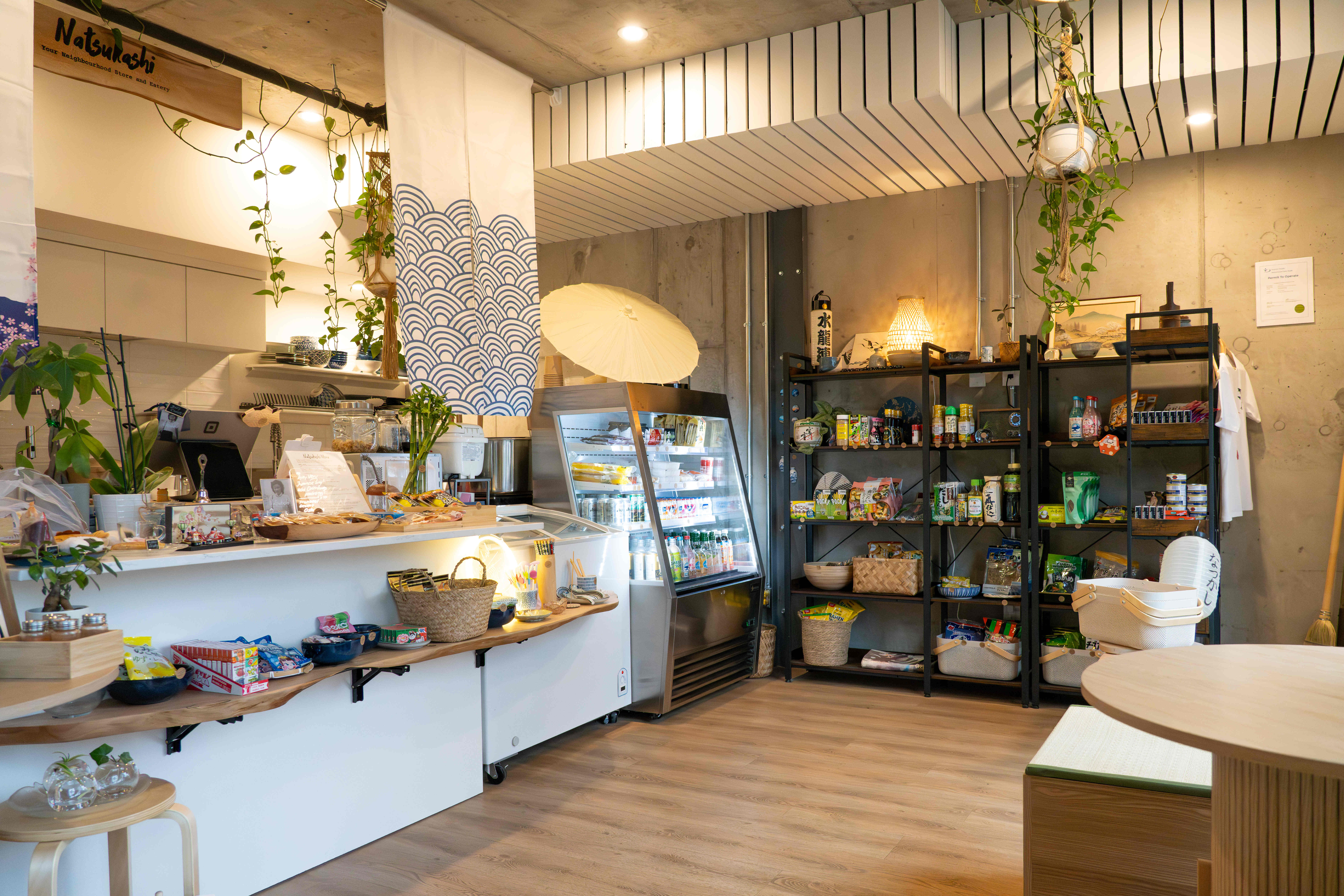
Another pointed example is Natsukashi Neighborhood Store and Eatery. In January, 2026, Natsukashi opened right next door to Komorebi Cafe and Healing Art Studio, a Japanese cafe specializing in matcha and hojicha lattes.
“I'm not just trying to provide food and beverage services. Both spaces serve as small cultural bridges,” says Luna Taniguchi, owner of both Natsukashi and Komorebi.
When asked to explain the concept behind her new store, Taniguchi told me that Natsukashi and Komorebi complement each other by fusing mindfulness with a warm nostalgia.
“The word ‘komorebi’ means sunlight filtering through the leaves. You know, I grew up in the countryside of Japan and I felt really close to nature. Standing under a tree or in a forest — that was my calm place. I wanted to provide this warm cozy space, filled with plants, all year round. So, Komorebi was focused on finding peace and comfort in the present moment.”
On the other hand, Natsukashi focuses on the past. “The word means nostalgia,” says Taniguchi. “Though it’s not so much a sadness about the past but more about remembrance and cherishing.”
Taniguchi was very deliberate in naming her store: “I don’t call Natsukashi a convenience store because that feels very commercialized. I'm trying to simulate the corner stores that I used to see growing up in Japan, where you just bring a few coins to buy sugar, or soy sauce, or snacks. Corner stores are more welcoming. The staff remembers you by your name. You feel cared for and seen. It's a neighbourhood store.”
Wooden tables, linen curtains, a little fridge and shelves filled with Japanese sauces, curry packs, and nostalgic candies, this store and eatery emits a pleasant energy that could transport Japanese residents in Kelowna back to their past. Propped on the cashier is a photo of Taniguchi’s grandmother when she was young.
“It's almost like stopping at your granny's home. You're hungry, and you want to grab something quick, but your nana tells you to sit down and cooks you something proper. You eat fast and you go, right? Natsukashi is something like that… ready to kind of catch you when you're busy and on the run but still need that comfort.”
The eatery has a simple menu consisting of Taniguchi’s childhood comfort meals like udon and onigiri, which are everyday staples and favourites of many Japanese people. Contrary to sushi which is usually eaten on special occasions in Japan, Natsukashi’s menu allows the Kelowna community to get a taste of what is enjoyed on a daily basis in Taniguchi’s home culture.
Tucked in a quiet neighborhood downtown, Natsukashi does not have the most discoverable location, yet Taniguchi’s stores are always packed and brimming with chatter. I wondered about the demographic of her customers. “This particular neighbour has a great number of non-Asian residents. I get a lot of people who moved here from Vancouver. They're eager for authenticity and more specialty shops,” she answered.
Specialty stores such as Komorebi and Natsukashi create a community based on Asian culture but bring a variety of demographics together. Regardless of race or ethnicity, people grow curious about authentic ingredients and dishes served in a catered atmosphere.
“I have a lot of people looking for ingredients that they cannot find elsewhere, like bonito flakes and natto,” adds Taniguchi, “and they are sometimes non-Asians who love cooking Asian food.” That is what Taniguchi means by creating a cultural bridge, which she views as increasingly important in the post-COVID era.
“After COVID, things got convenient with all the delivery services. People are more and more disconnected. They are connected with technology, but not connected in a ‘human’ or organic sense, but that organic connection is so important.” Taniguchi cherishes the face-to-face interactions she has with her customers, which is why she can often be seen inside one of her stores, behind the bar or kitchen or chatting with regulars.
Through good food, genuine conversations, and heartfelt interior design, Asian specialty stores like Natsukashi do more than the typical supermarket. They provide a space that comforts the homesick and gives the locals a chance to understand cultures beyond their own.
That said, such spaces should be available not only for Asian communities but also for those belonging to other minority cultures such as the African and Arab population in Kelowna. Food is not just a commercial product but also a symbol of home and a way to bring people together.
Each corner of Kelowna that offers access to Asian food and ingredients plays a part in fostering intercultural communication in this city, and that applies to the “international” section at Walmart, to Asian supermarkets like U-Box, and to Asian specialty stores like Natsukashi.



.png)

